Blog Detail
Posted on September 11, 2026 at 9:41 AM
Construction projects are becoming increasingly complex and require more contractors, consultants, suppliers, and resources to implement successfully. It becomes complicated to manage everything and make sure that everything is done right and on time. Project management office (PMO) is the secret to successfully managing big or complex projects and delivering them on time with minimum risk and meeting the company’s objectives.
According to research conducted by PMI in 2026, 97% of project managers dealt with at least one complex project in the last year and 81% of them said that project complexity is increasing. As per respondents, construction was defined as a complex industry in 53.3% of the cases.
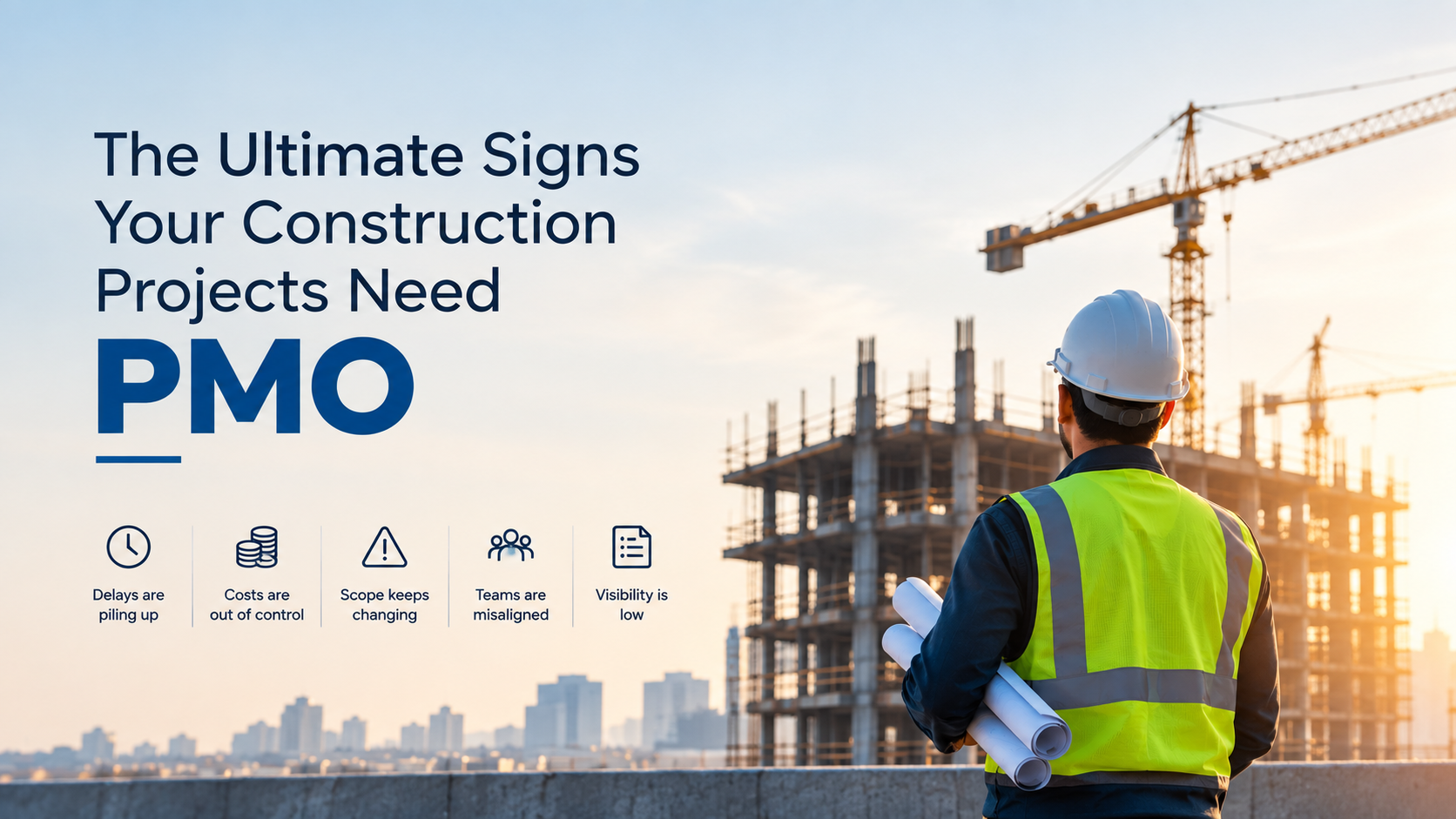
The Ultimate Signs Your Construction Projects Need PMO
These are the 5 signs that tell you need a project management office for construction:
1. You Are Managing Multiple Projects without Consistency
With different construction project reporting formats, processes, and risk-management practices, it becomes impossible to compare how different projects are performing. In addition, you often see duplicated effort or missed information.
A PMO can establish standardized processes, reporting templates, governance frameworks, and project controls across the portfolio. This increases your ability to control and compare projects without stifling individual project teams’ ability to manage tasks according to their site-specific needs.
2. Projects regularly exceed budgets or deadlines
Multiple projects that exceed their initial budgets and deadlines indicate that the organization must establish strict project control. According to research, 52% of projects experienced scope creep, causing an average 27% budget overrun.
Here, a project management office (PMO) plays a vital role. It can implement forecasting, progress, and risk tracking to identify deviations and take corrective action before minor issues become major cost or schedule impacts.
3. Stakeholder Communication Is Becoming Difficult
A PMO can provide centralized support, setting reporting requirements and facilitating stakeholder communication and information dissemination.
This is particularly important for complex projects, where PMI reports a 61% occurrence of value or alignment gaps and 55% of delivery disruptions, including schedule slippage and operational bottlenecks.
4. Your Project Teams Lack Capacity or Oversight
When the project manager has several priorities, they may neglect key strategic oversight, including critical risks. In addition, the project manager and team can waste time on reporting and informational tasks instead of focusing on issues that need to be avoided.
A PMO can add an extra layer of governance and oversight while aggregating project information. It can help enterprises identify which projects need intervention and resource reallocation.
The value of streamlined project management is clear: businesses that improve their project-management competency see a 49% rise in on-time delivery and a 40% improvement in on-budget delivery, according to the statistics cited by Speakwise.
5. You Are Preparing For Growth or a Complex Development
Growth can reveal shortcomings in areas that were previously poorly manifested due to the relatively small scale of projects within the organisation’s scope. As it grows, the need to standardize governance, resource management, and performance assessment procedures across larger developments and multiple projects emerges.
Therefore, understanding when you need a PMO in construction becomes essential. In other words, when an organization’s growth involves larger developments and greater project complexity, establishing a PMO before these challenges emerge can enable a more orderly transition to the next level of organizational maturity.
What A PMO Can Bring To Construction
A PMO is not just another level of management; it can provide an integrated approach to project planning, reporting, risk management, cost management and decision-making.
PMI’s 2026 analysis revealed that organisations which have a PMO have a 63% success rate in managing complex projects, as against 57% for organisations without a PMO. These organisations also have more structured frameworks, with 71% using an organised framework compared to 55% who don’t have a PMO.
The Road Ahead
The decision to create a project management office should be driven by the company’s size, project nature, complexity, and how well projects are controlled and monitored.
The question then becomes, does the construction company need a PMO, or does the current project-management system suffice? For simple projects, having a PMO is an unnecessary burden. For projects that are numerous, complicated, and challenging to manage, PMO brings a systematic approach and control.
80% of complex projects worldwide have faced some form of significant negative outcome due to inadequate project management control. Project management governance is therefore a strategic capability that should be invested in, depending on the size and complexity of the desired project.
OUR COMMITMENT TO EXCELLENCE
Our corporate vision is to build a better world through excellence, teamwork and innovation. Our commitment to excellence is the driving force behind everything we do. Our projects effortlessly stand the test of time and we continue to work with a sharp focus on timelines.