Blog Detail
Posted on June 11, 2026 at 10:24 AM
If you are currently overseeing a commercial build, an industrial warehouse, or a joint-venture property development in Eastern India, you are likely intimately familiar with the stress of watching timelines slip. But there is a much quieter, more expensive problem brewing on your site right now: construction invoice inflation.
In markets across West Bengal and Odisha, B2B construction projects regularly face 10% to 15% cost overruns due to loose billing reconciliation. When you rely solely on a local promoter or contractor to report material consumption and labor costs, you are essentially letting them grade their own exam papers.
Without independent engineering oversight, minor item variations and material over-ordering can quietly bleed your project capital dry. Here is how budget leaks happen in regional builds, how to identify them, and how an independent billing audit can save your project from financial failure.
The Hidden Leak: Why Eastern Indian Construction Projects Overrun Budgets
In major industrial and commercial hubs like Kolkata (Sector V, New Town), Durgapur, Haldia, and Bhubaneswar, the construction ecosystem is still heavily reliant on fragmented, manual reporting. Real estate layouts, structural modifications, and daily labor logs are often tracked on loose paper invoices or basic Excel sheets managed directly by the site supervisor.
When a single contractor controls the procurement, execution, and billing processes, a conflict of interest naturally arises. Landowners and corporate entities who may not have a background in civil engineering frequently approve running account (RA) bills simply to keep the project moving forward, unknowingly paying for materials that never actually made it into the physical structure.
3 Common Tactics Used to Inflate Local Construction Bills
To protect your construction budget, you need to know exactly where the inflation occurs. Independent project management audits typically uncover discrepancies in three primary categories:
1. Unreconciled Material Wastage
This is the most frequent source of budget drainage in Eastern India. Contractors frequently over-order high-value structural components, specifically steel rebar and cement bags.
-
The Tactic: The contractor bills the landowner for the total gross material delivered to the site. However, due to poor cutting practices, theft, or deliberate inflation, a significant portion is wasted or resold off-site. You end up paying for tons of steel that never actually entered your building’s foundations.
2. Deviations from Good-for-Construction (GFC) Drawings
Before a shovel hits the dirt, your structural engineers issue Good-for-Construction (GFC) drawings. These are the definitive technical blueprints for your project.
-
The Tactic: Contractors may make unapproved structural changes on-site, claiming they were “necessary field adjustments.” At the end of the month, they present unexpected “Extra Work” or “Deviation” invoices. Without a technical audit, it is impossible to verify whether these changes were genuinely required or constitute artificial cost padding.
3. Ghost Labor Logs and Stretched Timelines
During major structural phases such as deep excavation, piling, or RCC slab casting, the labor force scales up significantly.
-
The Tactic: Because tracking hundreds of daily wage workers across shifting sites is incredibly difficult for an off-site landowner, contractors frequently inflate daily man-hour logs. This artificially inflates your labor expenses while slowing the actual build speed.
Suspect Your Current Project is Over-Budget?
Don’t wait until the final handover to look for billing errors. Upload your current contractor invoice and structural layout to receive a Free 30-Minute Billing & Steel Quantity Reconciliation Check from our senior engineering auditors.
How an Independent PMC Conducts a Construction Bill Audit
An independent Project Management Consultancy (PMC) acts strictly as the landowner’s representative. They do not supply materials or labor; their sole job is to protect your capital and enforce technical accountability.
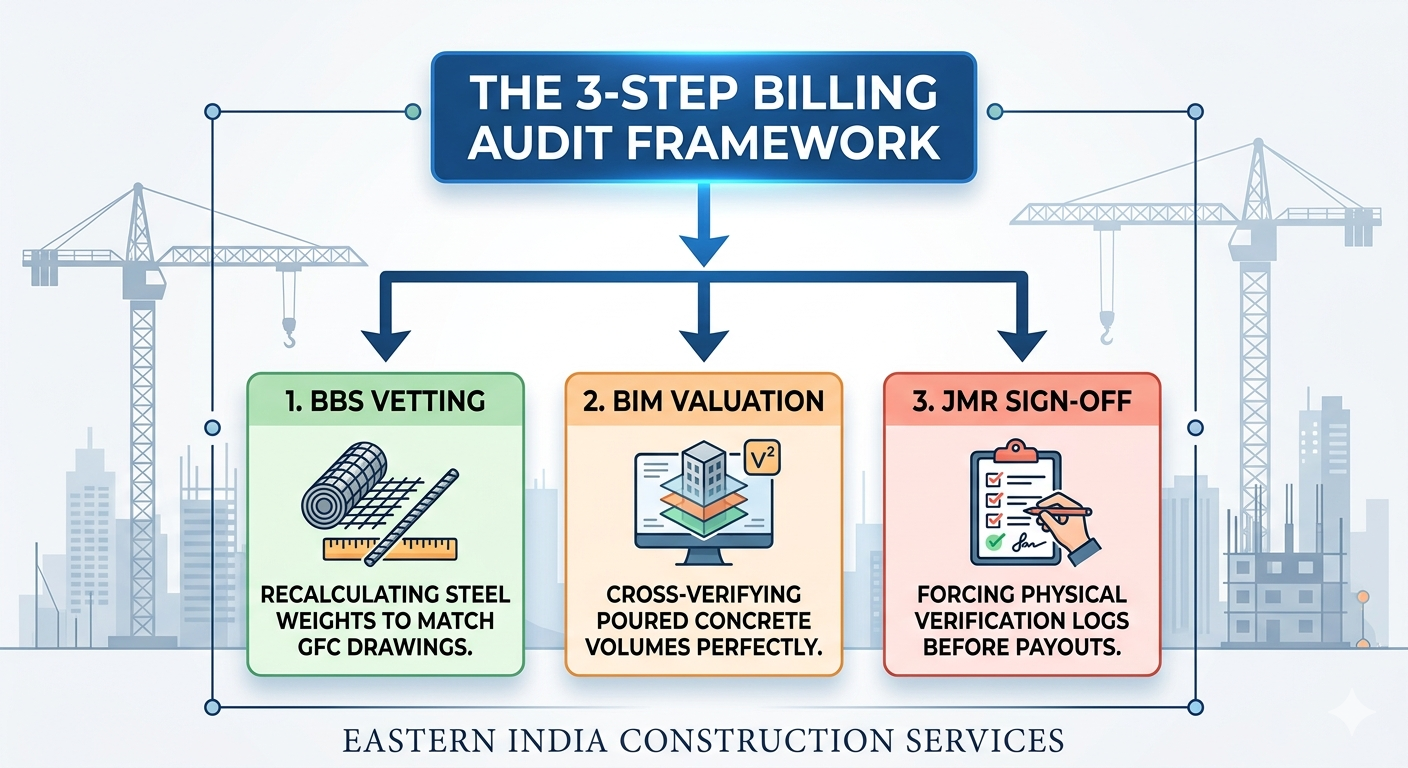
A professional construction billing audit relies on precise engineering math rather than guesswork:
Bar Bending Schedule (BBS) audit
-
Bar Bending Schedule (BBS) Vetting: Auditors manually recalculate steel requirements down to the millimeter and kilogram, comparing the contractor’s billed steel weight against the mathematical requirements of the structural drawings.
-
Volumetric Concrete Audits: Using precise site dimensions, engineers cross-verify poured concrete volumes mathematically against supplier delivery notes to catch raw invoice inflation.
-
Joint Measurement Records (JMR): The audit team forces contractors to physically co-measure and sign off on completed work milestones on-site before any financial disbursement or running account bill is authorized for payment.
Protect Your Capital Before the Handover
If your project in West Bengal or Odisha is experiencing creeping delays, unexpected material requests, or confusing “extra work” charges, the worst thing you can do is wait until the final bill to address it. Once concrete is poured and walls are finished, auditing the underlying materials becomes significantly more difficult.
Implementing independent cost controls mid-project allows you to correct the trajectory of your build, re-establish a transparent relationship with your contractor, and ensure that every single rupee itemized on your invoice directly reflects physical progress on the ground.
OUR COMMITMENT TO EXCELLENCE
Our corporate vision is to build a better world through excellence, teamwork and innovation. Our commitment to excellence is the driving force behind everything we do. Our projects effortlessly stand the test of time and we continue to work with a sharp focus on timelines.